

The recent death of actress Hayden Panettiere at age 36 is heartbreaking. On September 22, 2026, the Greenville County Coroner’s Office ruled her August 16 death accidental and attributed it to the toxic effects of fentanyl, 4-ANPP, alprazolam, methocarbamol, and quetiapine. Federal authorities continue to investigate the source of the drugs, and reporting has focused on whether nonprescription or counterfeit pills were involved.
It is important not to turn a person’s death into speculation. Public reporting does not establish exactly what Panettiere believed she was taking, or which specific product accounted for each substance found in toxicology. What the case does underscore is a much broader and increasingly urgent problem: the illicit pill supply can expose people to substances they never intended to take.
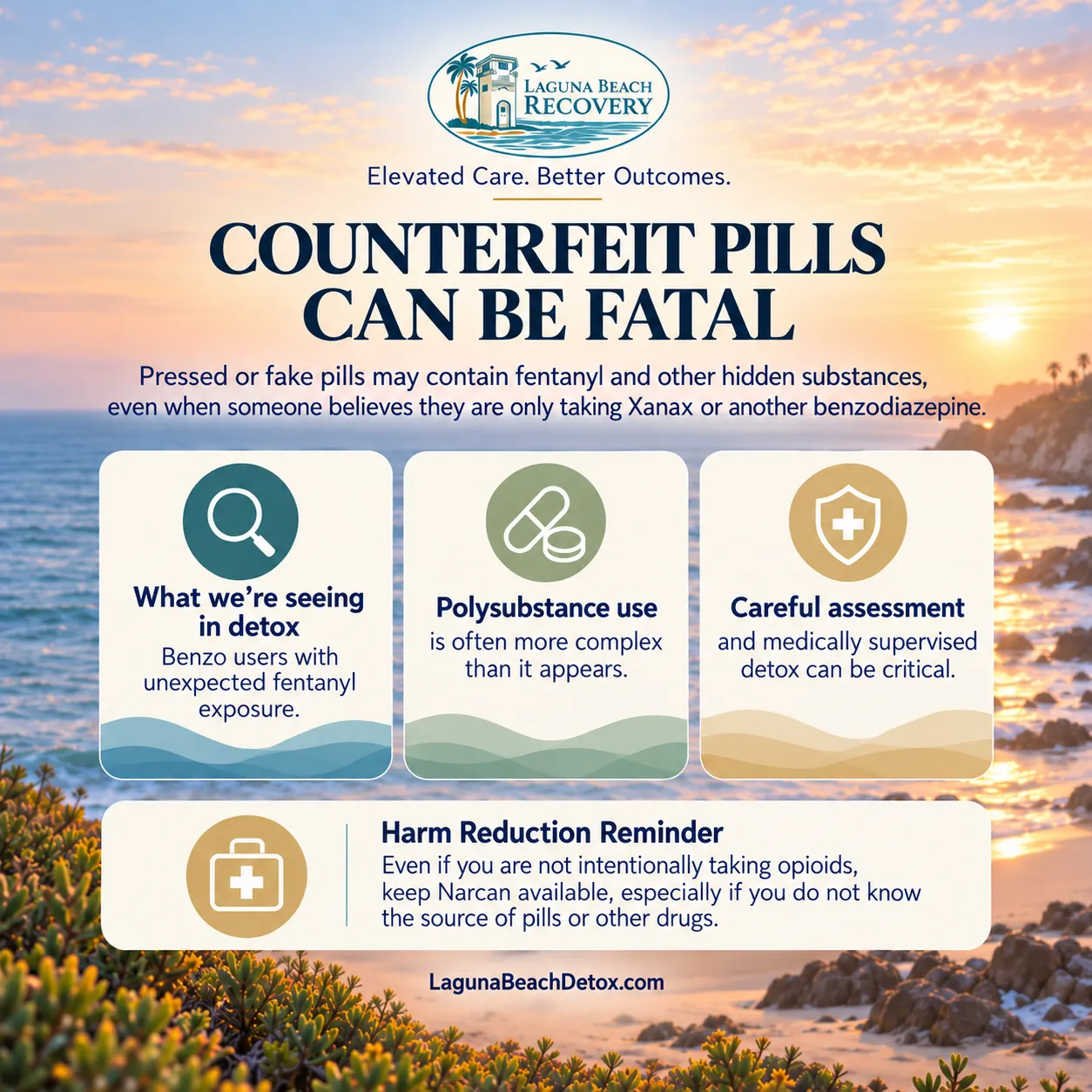
In today’s drug supply, someone may believe they are taking Xanax, oxycodone, Adderall, or another familiar medication and actually be taking a pressed counterfeit pill containing fentanyl, methamphetamine, illicit benzodiazepines, or a combination of substances. That changes both overdose risk and the way safe detoxification needs to be assessed.
A Pill Can Look Familiar and Still Be Something Else
Counterfeit pills are manufactured to look like legitimate prescription medications. They may carry familiar colors, shapes, numbers, or imprints and can be difficult to distinguish from pharmacy-dispensed medication by appearance alone.
The Centers for Disease Control and Prevention reports that illegally made fentanyl is increasingly pressed into counterfeit pills that resemble oxycodone and alprazolam, commonly known as Xanax. Fake pills may also be sold as stimulants such as Adderall. CDC materials report that in 2024, 5 out of 10 counterfeit pills tested contained a potentially deadly dose of fentanyl.
The practical takeaway is simple: if a pill did not come directly from a licensed pharmacy and was not dispensed for the person taking it, the imprint on the tablet is not proof of what is inside.
Why Benzodiazepine Use May Also Require Opioid Assessment
A person can honestly report, “I use Xanax,” and still have clinically meaningful opioid exposure if the pills came from an illicit or unknown source. Repeated exposure to fentanyl in counterfeit benzodiazepine pills can create opioid tolerance, opioid withdrawal risk, or opioid use disorder even when the person did not set out to use opioids.
That does not mean every person who uses benzodiazepines needs opioid detoxification. It does mean that clinicians should not assume a benzodiazepine user has only been exposed to benzodiazepines when pills were obtained outside a licensed pharmacy.
This distinction matters because benzodiazepine and opioid withdrawal are different clinical problems. Benzodiazepine withdrawal can become medically dangerous and, in some circumstances, can involve seizures or delirium. Opioid withdrawal requires its own assessment and treatment plan, and fentanyl exposure can complicate medication timing and withdrawal management. At the same time, combining opioids with benzodiazepines or other sedating medications increases the risk of respiratory depression and overdose.
In other words, a patient who presents for “benzo detox” may actually need a polysubstance withdrawal assessment that considers both benzodiazepines and fentanyl, along with alcohol, stimulants, other opioids, prescription medications, and any other substances that may be involved.
The Fentanyl Era Has Changed What a Good Detox Assessment Looks Like
The question “What drug are you using?” is no longer enough by itself. In an unpredictable illicit drug market, clinicians also need to understand where the substance came from, how consistently the person knows what they are taking, and whether the clinical picture suggests exposure to additional substances.
A thoughtful polysubstance detox assessment may include:
- The substances the person believes they are using, including brand names or street names.
- Whether pills were prescribed and dispensed by a licensed pharmacy or obtained from an illicit or unknown source.
- Frequency, amount, duration, route of use, and time of last use.
- History of withdrawal, seizures, delirium, overdose, or prior complicated detoxification.
- Signs and symptoms consistent with benzodiazepine, opioid, alcohol, stimulant, or other withdrawal syndromes.
- Other sedating medications or substances that can increase overdose risk when combined.
- Medical conditions, psychiatric symptoms, current medications, and prior treatment history.
- Toxicology and other clinical information when indicated, while recognizing that no single test replaces ongoing assessment.
This broader approach is increasingly important because unintentional polysubstance exposure is now part of the overdose landscape. CDC specifically describes counterfeit pills as a source of unintended fentanyl and other drug exposure.
How Laguna Beach Recovery Approaches Polysubstance Detox
At Laguna Beach Recovery, our licensed detoxification program is designed to evaluate the whole clinical picture, not simply the name printed on a pill. When someone reports benzodiazepines, opioids, fentanyl, counterfeit pills, alcohol, stimulants, or multiple substances, our clinical team assesses known and possible exposures, withdrawal risk, prior complications, medical needs, psychiatric symptoms, and the way those factors interact.
If fentanyl or another opioid exposure is identified in someone who primarily reports benzodiazepine use, the opioid component cannot be ignored. The withdrawal-management plan needs to account for each clinically relevant substance rather than treating one drug in isolation. Medication strategies, monitoring, and timing are individualized by the medical team based on the patient’s presentation and evolving symptoms.
The same principle applies in the other direction. A person seeking opioid detox may also have benzodiazepine, alcohol, stimulant, or prescription-medication exposure that changes the risk profile. Ongoing reassessment matters because the first history a patient provides may not capture everything in the drug supply they were exposed to.
When a person requires a level of medical intervention beyond what can be safely provided in a licensed detoxification setting, appropriate escalation to hospital-level care is part of safe treatment planning.

Harm Reduction: Carry Naloxone Even If You Are Not Intentionally Using Opioids
One of the most important harm-reduction messages in the fentanyl era is that naloxone is not only for people who identify as opioid users.
If you take pills from an unknown or non-pharmacy source, or use cocaine, methamphetamine, or other illicit substances that could be contaminated with fentanyl, keeping naloxone available can save a life. CDC states that anyone can carry naloxone. Naloxone can reverse an opioid overdose, including one caused by fentanyl, and it will not harm someone simply because opioids turn out not to be the cause of the emergency.
This is especially important for people who believe they are using benzodiazepines or other non-opioid drugs. If the substance unexpectedly contains fentanyl, an opioid overdose can occur even though the person never intended to take an opioid.
Fentanyl test strips can also reduce risk by identifying fentanyl in some drug products. They are not a guarantee of safety. CDC cautions that even a negative result should not be treated as proof that a substance is safe because strips may not detect every fentanyl-like drug, and the contents of illicit products can be inconsistent.
Practical Steps That Can Reduce Overdose Risk
No harm-reduction strategy makes an illicit pill or unknown drug completely safe. These steps can reduce risk:
- Only take prescription medication that was prescribed to you and dispensed by a licensed pharmacy.
- Treat pills from social media, friends, dealers, or other non-pharmacy sources as having unknown contents, even if they look identical to a prescription medication.
- Keep naloxone (Narcan) available and make sure the people around you know where it is and how to use it.
- Do not use drugs alone. A bystander with naloxone cannot help if no one is present.
- Use fentanyl test strips or other drug-checking services when available, while remembering that a negative result does not guarantee safety.
- Avoid mixing opioids with benzodiazepines, alcohol, or other sedating drugs because the combination can increase overdose risk.
- If an opioid overdose is suspected, call 911 and administer naloxone as soon as possible.
The Drug Someone Thinks They Took Is No Longer Enough Information
The rise of counterfeit pills has changed one of the basic assumptions of addiction treatment. A pill’s appearance, imprint, or street name no longer reliably tells clinicians what the patient was exposed to.
That is why safe detoxification starts with a broad assessment, careful monitoring, and the willingness to consider substances the patient may not have knowingly taken. For a person who believes they are dependent on benzodiazepines, that can mean evaluating for fentanyl and opioid withdrawal. For someone who believes they are using opioids, it can mean looking for benzodiazepines, stimulants, alcohol, and other substances that change the clinical picture.
The goal is not to assume the worst. It is to recognize the drug supply as it exists today and build a treatment plan around the patient’s actual risks, not simply the label on the pill.
If there is an immediate overdose, loss of consciousness, slowed or stopped breathing, seizure, severe confusion, or other medical emergency, call 911. Naloxone should be given when opioid exposure is possible while emergency help is on the way.
Concerned about fentanyl, counterfeit pills, benzodiazepines, or polysubstance withdrawal?
Laguna Beach Recovery can help assess whether medically monitored detoxification or residential treatment may be appropriate.
Call (844) 790-0028 or use our confidential insurance verification form to take the next step.
https://www.cdc.gov/overdose-prevention/about/fentanyl.html
https://www.cdc.gov/free-mind/about-substances/index.html
https://www.cdc.gov/overdose-prevention/about/polysubstance-overdose.html
https://www.cdc.gov/stop-overdose/naloxone-faq/index.html
https://www.cdc.gov/overdose-prevention/reversing-overdose/about-naloxone.html
https://www.asam.org/quality-care/clinical-guidelines/benzodiazepine-tapering
